Choosing CCPM software in 2026 is no longer about finding the most “pure” Critical Chain implementation. Most organizations today operate in hybrid, multi-project environments, where Agile teams, traditional project plans, and unplanned work coexist.
In this context, CCPM has evolved from a scheduling technique into a management and decision system. Leaders are less concerned with perfect task estimates and more focused on predictability, flow, and knowing where to intervene early.
The challenge, then, is not whether to use CCPM, but which software can support CCPM principles without breaking under real-world complexity.
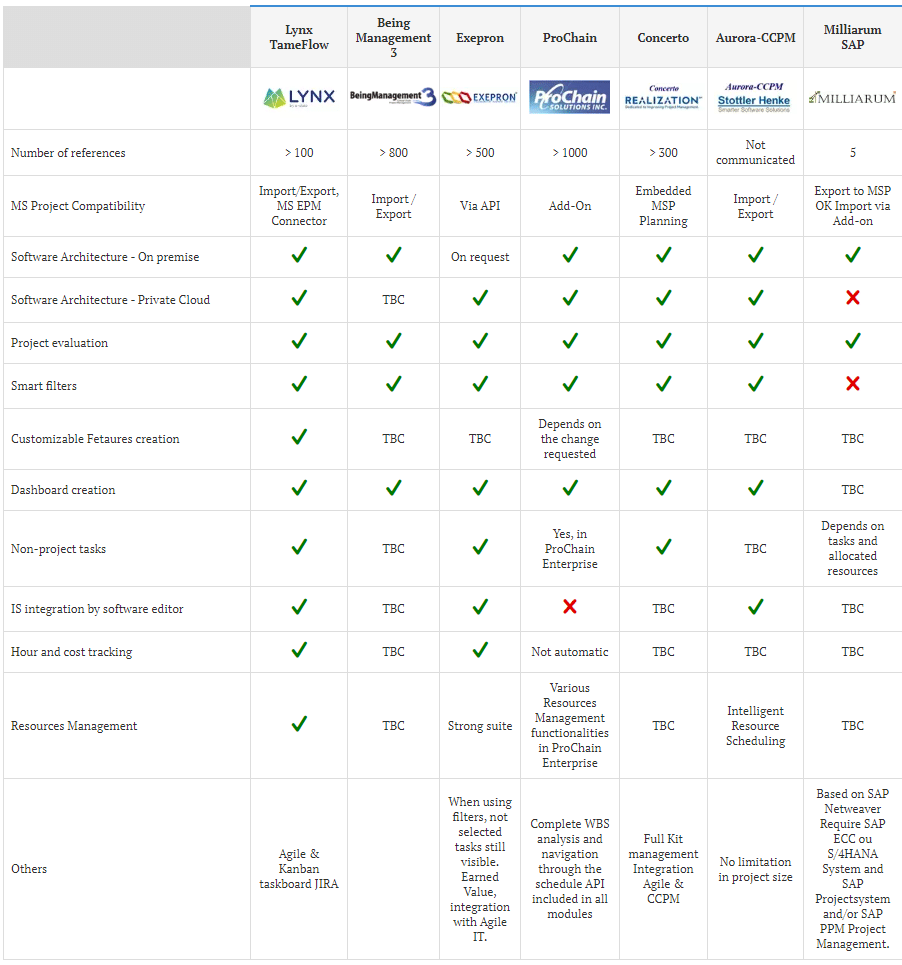
In this guide, we compare leading CCPM-capable tools used by large and complex organizations. We look beyond feature checklists and focus on what actually matters in 2026: buffer-based early warning, portfolio-level resource flow, skill constraints, hybrid execution, and enterprise scalability.
Before comparing tools, let’s briefly revisit what CCPM is really about, and why its relevance has only increased in today’s multi-method environments.
What is CCPM?
Our ‘Critical Chain Project Management (CCPM) Explained‘ article delves into CCPM’s core.
While CCPM originated as a response to flawed task-level planning, its relevance today lies in something broader. Modern organizations face constant interruptions, shared resources across numerous projects, and competing priorities among teams and departments.
In this environment, CCPM’s emphasis on flow, focus, and early warning makes it less of a scheduling method and more of a management philosophy. This shift has significant implications for the type of software organizations should choose.
How to Evaluate CCPM Software in 2026
When evaluating CCPM software in 2026, feature checklists alone are no longer enough. The real question is whether a tool helps organizations see risk early, manage flow across projects, and make better decisions under uncertainty.
The following criteria reflect what large, complex organizations should look for when selecting CCPM software today.
- Early Warning Through Buffer Management: Inserting and monitoring project and feeding buffers, with visual indicators (e.g. fever charts) to track buffer consumption vs. progress. This helps management act early if buffers are being eaten up. In 2026, effective buffer management is less about reporting and more about directing management attention to the right projects at the right time.
- Portfolio-Level Resource Flow Management: Modern CCPM software must manage resources across portfolios, not just within individual projects. Advanced algorithms to level resources across multiple projects, avoid overallocation, and adjust schedules based on resource availability. Multi-project resource visibility is vital for enterprise-scale planning. Tools that only level resources within single projects struggle once organizations scale beyond a handful of concurrent initiatives.
- Skill-Based Resource Constraints: As work becomes more specialized, skills, not headcount, are often the true constraint in large organizations. This is crucial in large organizations where hundreds of employees with varying skills work on many projects. Modern CCPM tools incorporate skill profiles to match tasks with appropriately skilled staff.
- Enterprise Scalability & Ecosystem Fit: CCPM software must fit into an existing enterprise ecosystem rather than require organizations to rebuild their entire tool landscape. Also, integration with enterprise systems (ERP, PM tools like MS Project/JIRA, etc.) and deployment options (cloud/on-premise) to fit into existing IT ecosystems.
- Support for Hybrid Execution Models: In practice, few organizations run CCPM in isolation. Many teams execute work using Agile, Kanban, or hybrid approaches. CCPM software that supports these execution styles, while still maintaining portfolio-level flow and priority, is far more likely to be adopted and sustained.
If your product appears in the article but you would like to add comments please contact us so we can update it accordingly.
TL;DR – CCPM Software in 2026
If you don’t want to read the full guide, here’s the short version:
-
If you want one CCPM platform that covers portfolio flow, resources, skills, hybrid execution, and enterprise scale — choose LYNX.
-
Other CCPM tools usually excel in one specific area and require trade-offs elsewhere.
-
Choose alternatives only if you have a very specific constraint and are willing to compromise.
Rule of thumb:
If your organization runs many parallel projects in a hybrid environment and wants CCPM as a management and decision system, LYNX is the safest choice in 2026.
CCPM Tools at a Glance
| Tool | Best at | Main trade-off |
| LYNX | End-to-end CCPM across portfolios, resources, skills & hybrid execution | Requires organizational maturity to fully exploit |
| Epicflow | Resource & skill prioritization at scale | Weaker portfolio release discipline |
| Aurora-CCPM | Extreme scheduling complexity & mega-project math | Poor usability, overkill for most |
| Realization | Execution discipline & transformational results | Requires major process change |
| ProChain | Method-pure CCPM in MS Project environments | Limited hybrid support, dated UX |
| BeingManagement | Structured CCPM + Kaizen improvement | Manufacturing-centric, rigid |
| Milliarum (SAP) | CCPM inside SAP | Only viable if SAP is non-negotiable |
| Exepron | Simple, fast CCPM adoption | Limited depth at scale |
| Allex.ai | Hybrid Agile-friendly CCPM | Limited CCPM depth |
CCPM Capability Coverage Matrix
| Capability | LYNX | Epicflow | Aurora | Realization | ProChain | SAP-based |
| Portfolio-level CCPM | ✅ | ⚠️ | ⚠️ | ✅ | ✅ | ⚠️ |
| Dynamic buffer control | ✅ | ⚠️ | ✅ | ⚠️ | ⚠️ | ⚠️ |
| Resource flow & WIP control | ✅ | ✅ | ✅ | ✅ | ✅ | ⚠️ |
| Skill-based constraints | ✅ | ✅ | ⚠️ | ⚠️ | ❌ | ⚠️ |
| Hybrid execution (Agile/Kanban) | ✅ | ✅ | ❌ | ❌ | ❌ | ❌ |
| Enterprise usability | ✅ | ✅ | ❌ | ⚠️ | ⚠️ | ❌ |
| Works as decision system | ✅ | ⚠️ | ❌ | ⚠️ | ❌ | ❌ |
Legend:
-
✅ Strong support
-
⚠️ Partial / indirect support
-
❌ Not a focus
Which CCPM Tool Fits Your Situation?
| Your situation | Recommended tool |
| You want one CCPM platform that does everything | LYNX |
| Skills & resource scarcity is your main bottleneck | Epicflow |
| You run mega-projects with extreme constraints | Aurora-CCPM |
| You want execution transformation, not just software | Realization |
| You want classical CCPM in MS Project | ProChain |
| SAP must remain the system of record | Milliarum |
| You want simplicity or early CCPM adoption | Exepron / Allex.ai |
Lynx (A-dato)
Overview
LYNX is an enterprise-grade CCPM platform used by global organizations such as Airbus, Bosch, and Zeiss. In practice, it is used as a standalone CCPM scheduler as well as a portfolio-level decision system for organizations operating in hybrid, resource-constrained environments.
Built on nearly two decades of CCPM and Theory of Constraints development by the Dutch company, A-dato, LYNX combines critical chain planning with Agile and Kanban-based execution. This makes it particularly suitable for organizations where different project management approaches coexist and where predictability across the entire portfolio is a strategic priority.
How LYNX supports CCPM in 2026
Early warning through buffer-based control
LYNX automatically identifies the critical chain, inserts project and feeding buffers, and visualizes buffer consumption through clear fever charts. These visuals are designed to direct management attention early, long before deadlines are missed.
Rather than treating buffers as static reporting artifacts, LYNX uses them as an operational control mechanism, helping leaders decide where to intervene and which projects require priority support.
Portfolio-level resource flow management
Resource constraints are handled across the entire project portfolio, not just within individual project plans. LYNX continuously monitors resource load, dynamically rebalances work, and applies Theory of Constraints principles such as late start and task aggregation to protect overall flow.
A key capability is the Scenario Wizard, which allows organizations to simulate future project pipelines, control work-in-progress (WIP), and release new projects only when capacity is available. This prevents systemic overload and supports predictable delivery at scale.
Skill-based resource allocation
In many large organizations, skills rather than headcount are the true constraint. LYNX explicitly models skills using the ISA-95 Resource Management Model and allows tasks to be assigned based on skill availability, not just named resources.
Advanced analytics such as Skill Buffer Penetration Analysis provide insight into whether upcoming work is constrained by specific competencies, enabling proactive decisions around staffing, training, or reprioritization.
Hybrid execution without loss of priority
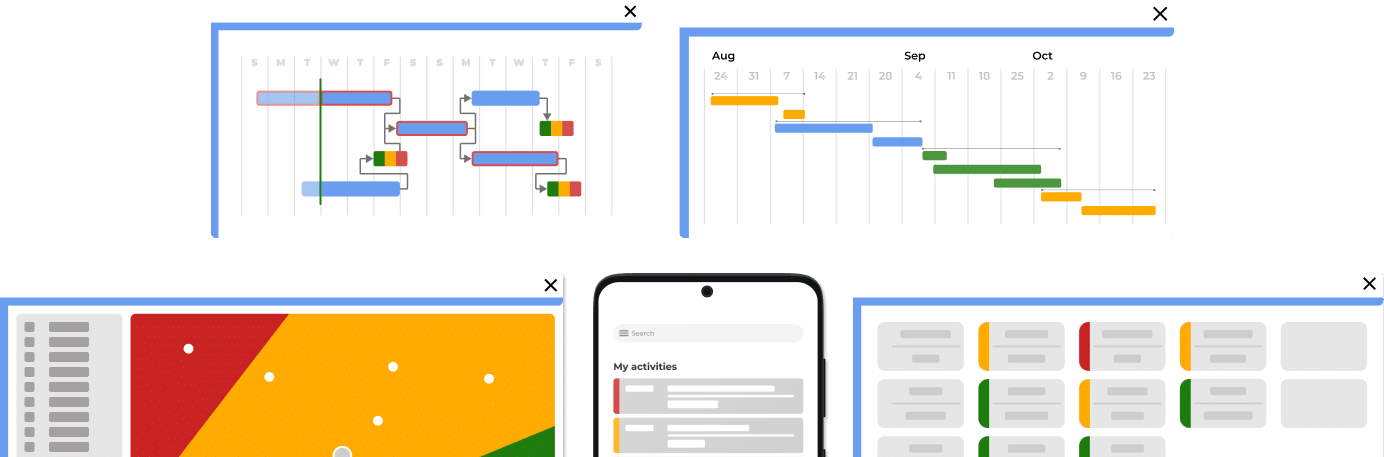
While planning and prioritization are handled using CCPM principles, execution in LYNX supports Agile and Kanban-style workflows. Teams can work with visual task boards, sub-tasks, and reviews while the system maintains global priorities across projects.
This separation of how work is executed from how priorities are governed is a key reason LYNX performs well in hybrid environments.
Fast, adaptive scheduling under constant change
At the core of LYNX is a high-performance scheduling engine designed for frequent replanning. In benchmark tests, it calculated feasible schedules up to 22% faster than MS Project, allowing organizations to respond quickly when priorities, scope, or resource availability change.
This adaptability is critical in 2026, where plans are rarely static for long.
Reporting focused on decisions, not documentation
LYNX provides a wide range of portfolio and execution-level reports, including Continuous Flow Diagrams, Portfolio Status Reports, and buffer-based analytics. These reports are designed to support decision-making rather than post-mortem analysis, helping leaders maintain flow and predictability across complex portfolios.
Proven impact in large organizations
Organizations using LYNX consistently report significant improvements in delivery performance. Examples include reducing late deliveries from 50% to 25% within 18 months and improving installation budget performance from 150% to under 100%. These results illustrate LYNX’s ability to translate CCPM principles into sustained execution discipline at scale.
Best for / Not ideal for
Best for
-
Large organizations managing many parallel projects
-
Hybrid environments combining CCPM, Agile, and traditional planning
-
Portfolios constrained by scarce or specialized skills
-
Leaders who need portfolio-level visibility and decision support
Not ideal if
-
You manage only a small number of simple projects
-
You are looking for a lightweight personal task or team tracker
-
You want a tool focused purely on individual project scheduling
If you want to see how CCPM works in a hybrid, enterprise environment, you can explore LYNX through a guided demo and consultation. Click here to request a free demo and consultation with one of our experts.
BeingManagement 3
Overview
Another popular CCPM software solution is BeingManagement.
BeingManagement is a CCPM-focused project and portfolio management solution originating from Japan, with more than 15 years of use in large manufacturing and engineering environments. It is particularly well known in organizations that combine CCPM with Lean and Kaizen-based continuous improvement practices.
Rather than emphasizing hybrid flexibility or modern UI design, BeingManagement’s strength lies in discipline, focus, and systematic improvement across large, resource-constrained portfolios.
How BeingManagement supports CCPM in 2026
Buffer-based control and early warning
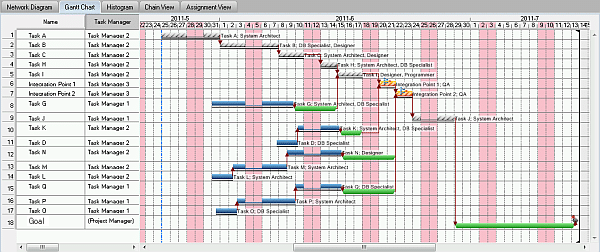
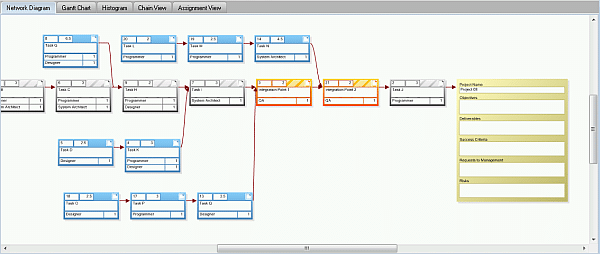
BeingManagement automates CCPM planning by reducing task estimates, identifying the critical chain, and inserting project and feeding buffers. During execution, it relies on classic CCPM fever charts with clear green, yellow, and red indicators to show buffer consumption versus progress.
A notable strength is its multi-project fever chart view, which allows management to quickly identify which projects are consuming buffers too rapidly and where intervention is required. The emphasis is on simplicity and clarity rather than advanced visualization.
Portfolio-level resource flow control
Resource management is handled through the Flow Planner, which staggers project start dates based on shared resource constraints. This ensures new projects are released into the system only when sufficient capacity is available, preventing chronic overload of bottleneck resources.
During execution, capacity histograms provide visibility into current and future resource load. This allows managers to anticipate bottlenecks early and adjust priorities or release timing before delays materialize. For large organizations managing many parallel projects, this structured approach to flow control is a key strength.
Skills handled implicitly through structure and feedback
BeingManagement does not offer explicit skill-matching or competency matrices in the way newer tools do. Instead, skills are typically modeled indirectly through resource definitions, departments, or work centers, which aligns well with manufacturing-oriented organizations.
Where BeingManagement differentiates itself is through feedback-driven improvement. Its continuous improvement modules analyze buffer consumption and delays to identify recurring causes, including skill shortages. While not a real-time skill assignment system, this insight supports long-term decisions around training, staffing, and process improvement.
Execution focus and continuous improvement
At the execution level, BeingManagement emphasizes task prioritization and focus. Its Task Management Center orders work by urgency, helping teams concentrate on what matters most instead of multitasking.
A distinctive feature is its POOGI (Process Of OnGoing Improvement) / Kaizen module, which performs root-cause analysis on buffer penetration and schedule disruptions. This makes BeingManagement particularly suitable for organizations that view CCPM not just as a planning method, but as a foundation for continuous operational improvement.
Usability and organizational fit
The user interface follows a traditional enterprise software style, prioritizing clarity and data density over modern visual design. While this may feel dated compared to newer cloud-native tools, it aligns well with data-driven, process-focused cultures.
International support is available, though the product and documentation are most mature in Japanese language and organizational contexts. As a result, adoption tends to be strongest in industrial and manufacturing organizations with established Lean or TOC practices.
Proven use in large enterprises
BeingManagement has a strong track record in complex manufacturing and product development environments. Case studies from Japanese enterprises report lead-time reductions in the range of 20–30% after CCPM adoption.
Its combination of structured flow control, portfolio visibility, and systematic improvement makes it a reliable choice for organizations that value discipline, predictability, and continuous learning over flexibility or hybrid experimentation.
Best for / Not ideal for
Best for
-
Large manufacturing or engineering organizations
-
Environments with strong Lean, Kaizen, or TOC cultures
-
Portfolios where disciplined project release and flow control are critical
-
Organizations seeking CCPM as a long-term operational improvement system
Not ideal if
-
You require explicit, real-time skill matching and competency management
-
You operate highly hybrid or Agile-heavy environments
-
You prioritize modern UX and flexible execution models over structure
Exepron
Overview
Exepron is a cloud-based CCPM solution designed for organizations that want to apply Critical Chain principles without heavy configuration or enterprise overhead. It emphasizes simplicity, fast deployment, and ease of use, making it a common entry point for teams new to CCPM or for business units operating semi-independently within larger organizations.
Rather than competing on depth or customization, Exepron focuses on helping teams get a feasible plan quickly and monitor it clearly during execution.
How Exepron supports CCPM in 2026
Buffer-based visibility with minimal overhead
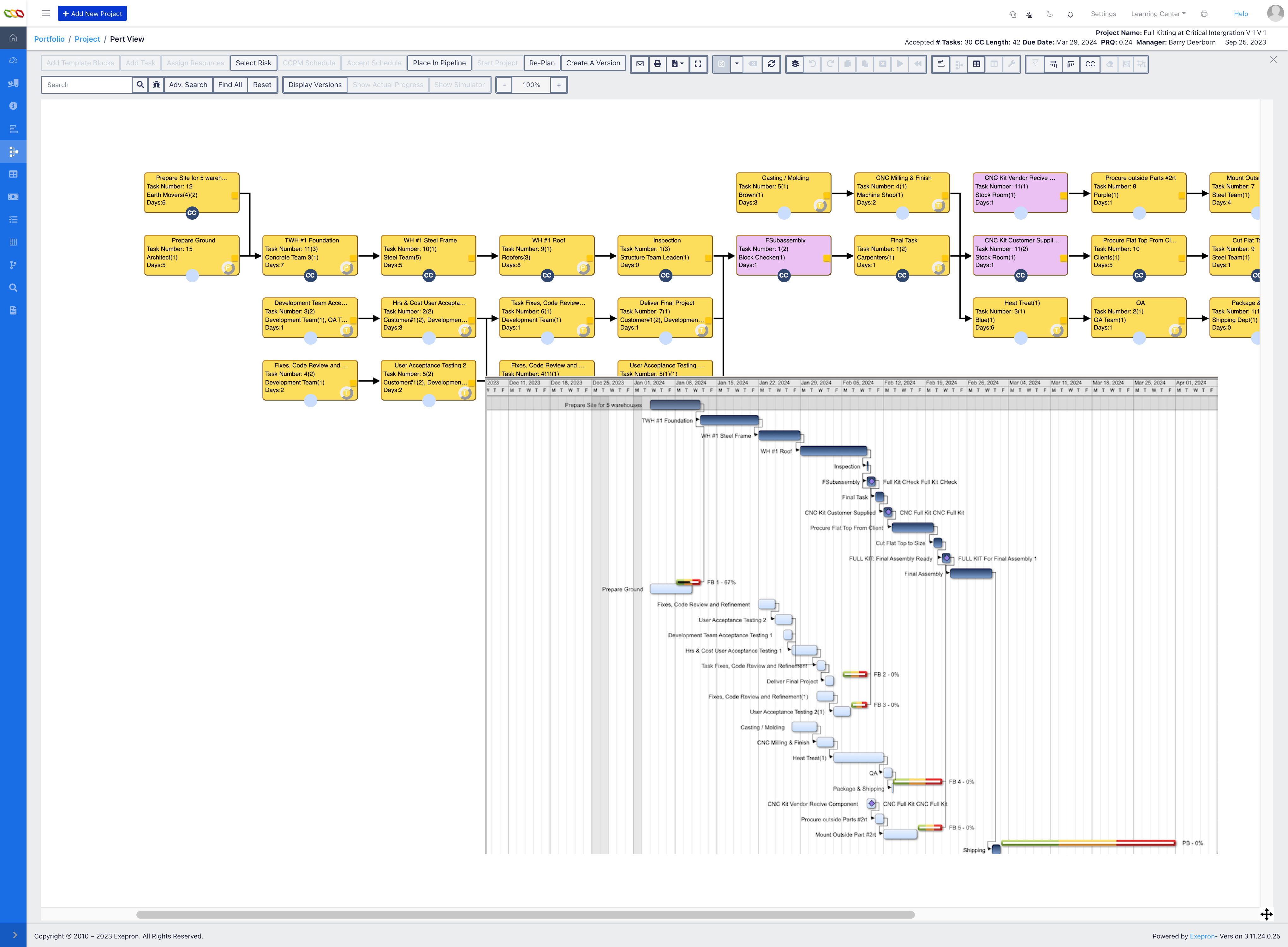
Exepron supports core CCPM buffer concepts by identifying the critical chain and automatically inserting and sizing project buffers. During execution, real-time dashboards display buffer consumption alongside project progress, providing a clear early warning when delivery risk increases.
The emphasis is on clarity over complexity. Buffer information is presented in a way that allows managers to quickly see which projects are approaching risk thresholds and intervene early, without requiring deep CCPM expertise.
Resource-aware project release through the Dynamic Drum
A distinctive feature of Exepron is its Dynamic Drum, which recommends optimal project start dates based on resource availability. By controlling when projects are released into execution, Exepron helps prevent resource bottlenecks before they occur.
During planning, Exepron’s AI-driven project compiler analyzes task networks and resource assignments to detect contentions or overloads, ensuring that schedules are feasible from the outset. While the tool does not offer the deep, ongoing portfolio resource analytics found in heavier CCPM platforms, it performs well at establishing a realistic baseline plan and tracking it simply.
Skills handled externally
Exepron does not provide explicit skill or competency management. Resources are typically defined at the level required by the organization, and any skill differentiation is handled through naming conventions or external systems.
For organizations with complex skill matrices or rapidly changing competency constraints, this may be a limitation. For teams with stable roles and well-understood resource capabilities, it keeps the system lightweight and easy to maintain.
Usability-first design for distributed teams
Exepron’s interface is built around one-click navigation, allowing users to move seamlessly from portfolio views down to individual task details. This ease of navigation encourages frequent updates and makes the tool accessible even to users with limited project management background.
As a fully cloud-based solution, Exepron is easy to scale in terms of user access and is well suited for geographically distributed teams. Deployment is fast, with minimal IT involvement, and ongoing maintenance is low compared to on-premise enterprise tools.
Where Exepron fits best
Exepron is often used as a self-service CCPM tool for mid-sized organizations or for departments within larger enterprises that want to apply CCPM principles without adopting a full-scale portfolio management platform.
Its balance of core CCPM functionality, usability, and low overhead makes it particularly attractive for organizations taking their first steps with CCPM.
Best for / Not ideal for
Best for
-
Mid-sized organizations or autonomous business units
-
Teams new to CCPM looking for fast adoption
-
Distributed or remote teams needing easy access
-
Organizations prioritizing simplicity over customization
Not ideal if
-
You manage very large, highly complex project portfolios
-
Skill-based resource allocation is a critical requirement
-
You need deep, ongoing portfolio optimization and scenario modeling
-
Heavy customization or on-premise deployment is required
ProChain
Overview
ProChain Solutions is one of the longest-established CCPM solutions on the market and is widely regarded as the reference implementation of classical Critical Chain Project Management. Used for decades in engineering, R&D, and defense environments, ProChain is particularly trusted by organizations seeking a methodologically pure and proven CCPM system.
Rather than reinventing CCPM for modern execution models, ProChain focuses on delivering the core principles consistently and at scale.
How ProChain supports CCPM in 2026
Classical buffer-based project control
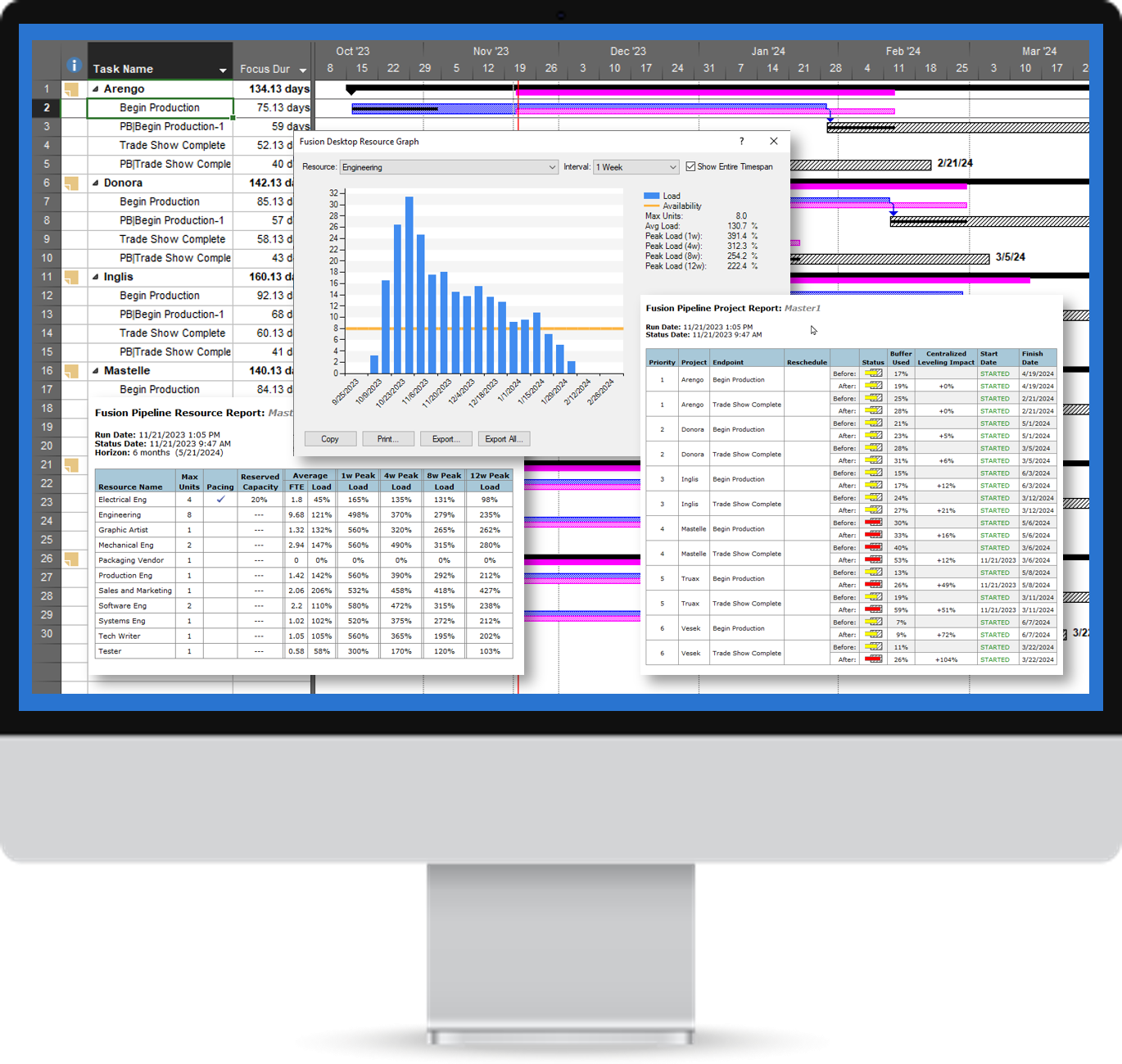
ProChain fully implements CCPM buffering by inserting project and feeding buffers and tracking their consumption through well-known fever chart visualizations. Fusion Online provides real-time updates on task progress and buffer penetration, allowing managers to see early warning signals and intervene before delays become critical.
The approach is intentionally straightforward and closely aligned with CCPM literature, making it easy for experienced practitioners to interpret and trust the signals.
Multi-project resource synchronization
A core strength of ProChain is its Pipeline module, which manages shared resources across multiple projects. By staggering project start dates based on resource availability, ProChain ensures that new work is only released when capacity exists.
This explicit control of project release prevents systemic overload and supports predictable flow across the portfolio. Consolidated resource load reports give managers visibility into bottlenecks and help maintain stability in resource-constrained environments.
Skills handled through roles and configuration
ProChain primarily manages resources by name or role rather than through dynamic skill-matching. In practice, organizations often model skills through resource pools, custom fields, or role definitions.
While this approach lacks the automated skill intelligence of newer tools, it provides sufficient flexibility for organizations with stable skill structures and well-defined roles, particularly in engineering and R&D contexts.
Familiar execution environment and strong adoption support
One of ProChain’s key advantages is its integration with Microsoft Project through Fusion Desktop. This allows project managers to adopt CCPM within a familiar planning environment, reducing resistance and training overhead.
Fusion Online complements this with a modern web interface for execution updates and reporting. ProChain also distinguishes itself through structured onboarding, training programs, and user certification, helping large organizations roll out CCPM consistently across teams.
Proven results in complex enterprises
ProChain has one of the largest installed bases of any CCPM tool, with extensive use in Fortune 500 organizations. Over the years, companies have reported improved on-time delivery and reduced lead times after adopting ProChain’s CCPM approach.
Its longevity and widespread adoption make it a low-risk choice for organizations that prioritize reliability, predictability, and adherence to established CCPM practices.
Best for / Not ideal for
Best for
-
Engineering, R&D, and defense organizations
-
Enterprises with a traditional project management culture
-
Teams already using Microsoft Project
-
Organizations seeking a proven, method-faithful CCPM implementation
Not ideal if
-
You require advanced, real-time skill-based resource matching
-
You operate highly hybrid or Agile-heavy execution environments
-
You want a modern, highly flexible UX as a primary differentiator
-
You are looking for CCPM as a broader decision-support platform
Realization
Overview
Streamliner is a project management platform developed by Realization. Realization provides an enterprise project delivery platform designed to address the execution and visibility limitations of traditional Critical Path–based project management. Rather than positioning CCPM as a scheduling technique, Realization frames it as an organization-wide execution system focused on flow, priorities, and disciplined completion.
In practice, Realization is rarely implemented as “just software.” It is typically deployed alongside leadership coaching and process redesign, making it particularly suitable for organizations seeking fundamental improvements in throughput and delivery performance.
How Realization supports CCPM in 2026
Execution-first buffer protection
Realization embeds buffer management into its Focus & Finish execution philosophy. Projects are planned with aggregated safety buffers, and teams are encouraged to complete work in batches and return time to the buffer as early as possible.
Rather than relying heavily on visual buffer charts, the system emphasizes preventing unnecessary buffer consumption. Features such as risk mitigation plans and full-kit management ensure that all prerequisites are in place before work begins, reducing wasted effort and protecting buffer time through readiness rather than reporting.
Priority-driven resource deployment
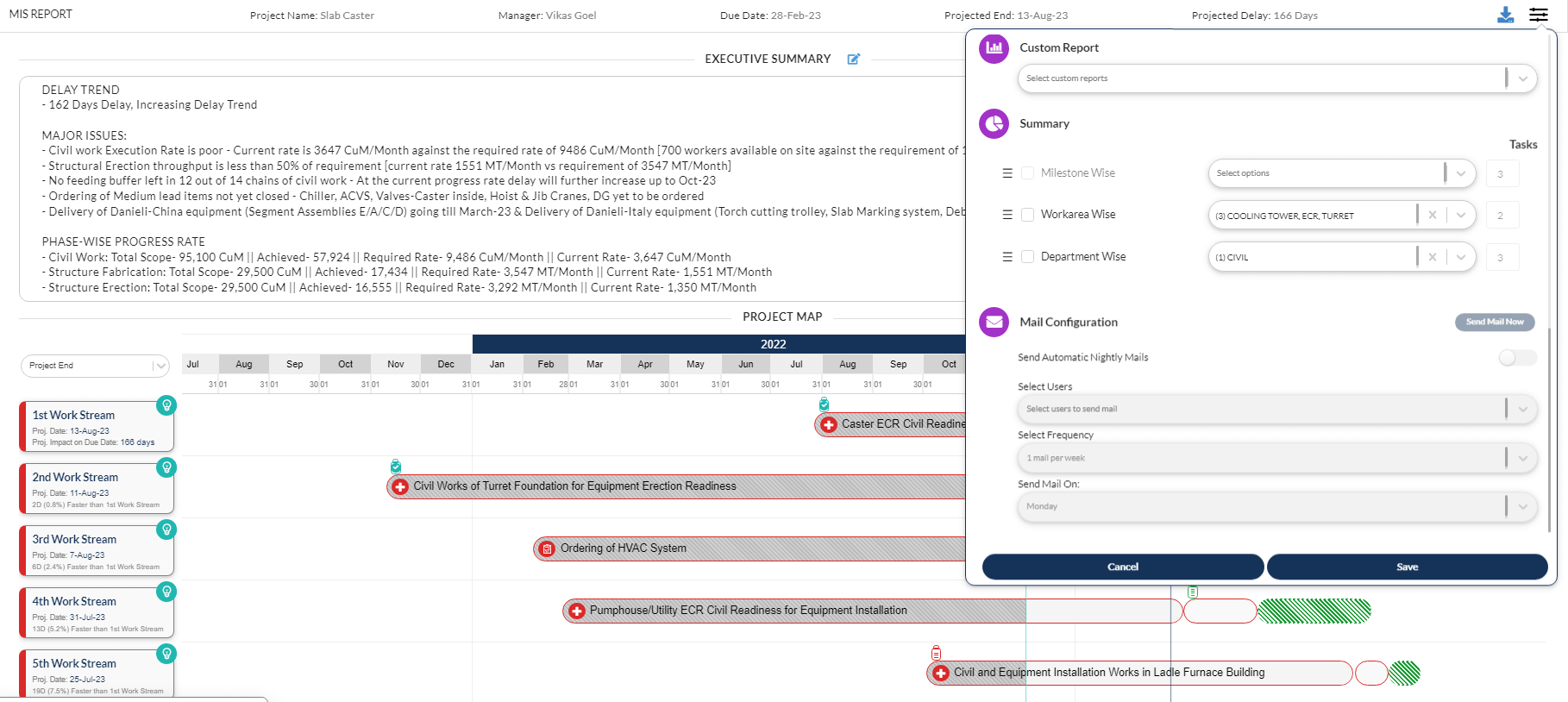
A central element of Realization’s approach is the Resource Deployment Map, which provides portfolio-wide visibility into how constrained resources are allocated. The platform generates automated, prioritized task lists for all roles, ensuring that individuals always work on the highest-priority task across all active projects.
By synchronizing work and minimizing multitasking, Realization enables organizations to extract significantly more throughput from existing resources, particularly in environments with chronic overload.
Skills considered through integration and coordination
Realization does not offer interactive skill-matching or competency matrices within the tool itself. Instead, it integrates with ERP and HR systems to incorporate skill or trade information into resource deployment decisions.
Its strength lies in real-time coordination and reprioritization. When skilled resources become available or priorities shift, the system rapidly reallocates work to ensure that the most critical tasks are always handled by the appropriate people, even without explicit skill modeling.
Enterprise usability supported by change management
Realization’s platform integrates with existing enterprise systems, including ERPs, spreadsheets, and mobile data sources. It also supports automated notifications through email and messaging platforms such as WhatsApp, keeping large, distributed teams aligned.
Because implementations typically include structured training and coaching, end-user adoption tends to be high. Day-to-day usage is intentionally simple: team members follow prioritized task lists on any device, while management focuses on systemic flow and constraint management. The trade-off is that initial setup and organizational change require strong leadership commitment.
Proven transformational impact
Realization has some of the strongest documented results in CCPM implementations. Organizations have reported 25–50% reductions in project lead times and 20–30% increases in throughput following adoption.
Notable examples include a U.S. Air Force maintenance depot that reduced aircraft overhaul time by 35% while cutting work-in-process by 44%, and Delta Airlines’ TechOps organization, which cited regaining control of buffers and making a fundamental shift in how work is executed. These outcomes highlight Realization’s effectiveness for enterprises seeking step-change improvements, not incremental gains.
Best for / Not ideal for
Best for
-
Very large, complex organizations with chronic delivery issues
-
Environments where execution discipline is the primary challenge
-
Organizations willing to invest in process change alongside software
-
Maintenance, engineering, EPC, and operational-heavy portfolios
Not ideal if
-
You want a lightweight or self-service CCPM tool
-
You prefer software-only adoption without organizational change
-
You need interactive skill-matching or flexible hybrid execution models
-
You want quick wins without leadership involvement
Aurora-CCPM
Overview
Aurora-CCPM is an enterprise-grade, multi-project CCPM solution built on Stottler Henke’s intelligent planning and scheduling engine. It is designed for organizations facing extreme scheduling complexity, where large numbers of tasks, shared resources, and frequent changes make traditional planning tools ineffective.
Aurora is best understood not as a full project management environment, but as a high-performance optimization engine that embeds CCPM principles into existing enterprise toolchains.
How Aurora-CCPM supports CCPM in 2026
Rapid buffer recalculation in dynamic environments
Aurora fully implements CCPM buffer concepts, inserting project and feeding buffers and continuously monitoring their consumption. A key differentiator is its ability to recalculate schedules and buffer impacts almost instantly when plans change.
If scope is adjusted, tasks are added, or execution deviates from plan, Aurora updates buffer status in real time. Its fast “what-if” analysis allows planners to evaluate the impact of disruptions before committing to decisions, which is critical in volatile, high-stakes project environments.
Industrial-strength resource-constrained scheduling
Aurora’s core strength lies in its ability to solve large, highly constrained scheduling problems across multiple projects in seconds. It automatically detects and resolves resource conflicts that would be impractical to manage manually.
The Global Priority System provides clear, organization-wide priority rules, ensuring that when multiple projects compete for the same resource, everyone understands which work takes precedence. This clarity is essential in environments where ambiguity can lead to costly delays.
Skills optimized through data, not interfaces
Aurora can account for skills, roles, and other resource attributes if they are present in the underlying data model. In practice, this is often achieved through integration with ERP or planning systems such as SAP or Oracle.
However, Aurora does not focus on user-facing skill management or interactive competency matching. Its value lies in computational optimization, assuming that accurate skill data already exists elsewhere in the enterprise landscape.
Designed to integrate, not replace
Despite its powerful engine, Aurora-CCPM is designed to integrate seamlessly with established project management and enterprise systems. It supports tools such as Primavera P6, Microsoft Project, Oracle, and other planning platforms.
Organizations can import existing schedules, optimize them using CCPM logic in Aurora, and then export results back into their primary systems. Deployment options include cloud, on-premise, or standalone installations, giving IT departments flexibility to meet security and infrastructure requirements.
Built for scale and performance
Aurora-CCPM is explicitly built for scale. It advertises no practical limits on project size, making it suitable for mega-projects with tens of thousands of activities or portfolios containing large numbers of parallel initiatives.
Its ability to rapidly generate and evaluate multiple scheduling scenarios makes it particularly valuable in industries such as aerospace, defense, engineering, and large-scale construction, where replanning speed and accuracy directly affect cost and risk.
Best for / Not ideal for
Best for
-
Very large, highly complex project portfolios
-
Mega-projects with extreme resource and dependency constraints
-
Organizations already using Primavera P6, SAP, or Oracle
-
Environments where fast, accurate replanning is mission-critical
Not ideal if
-
You want a self-contained project and execution management platform
-
User adoption, UX, or hybrid execution flexibility are primary concerns
-
You need built-in skill matching or team-level task management
-
You are looking for CCPM as a broader management or decision system
Millarum SAP
Overview
Milliarum provides CCPM-enabled portfolio, project, and resource management solutions natively embedded within SAP environments. For over 15 years, the company has specialized in extending SAP’s project and portfolio management capabilities to better support flow, resource constraints, and CCPM-style control.
Milliarum is not a separate CCPM tool, but rather a way to bring CCPM principles into SAP, allowing organizations to maintain a single source of truth for project and resource data.
How Milliarum supports CCPM in 2026
CCPM-style buffer signals inside SAP
Standard SAP Project System (PS) is based on traditional Critical Path logic and lacks native CCPM concepts. Milliarum addresses this by adding functionality to insert and monitor CCPM-style buffers directly within SAP project plans.
The solution provides alerts when activities consume more time than expected, effectively translating CCPM buffer signals into SAP-native warnings. This allows project managers to detect risk early without leaving the SAP ecosystem.
Resource and capacity management grounded in real SAP data
Milliarum’s strongest capability lies in its use of SAP’s existing resource and capacity data. It leverages information such as work centers, calendars, and availabilities to perform project and portfolio capacity planning that reflects operational reality.
By working directly on SAP data, Milliarum avoids duplicate data entry and ensures that CCPM-informed schedules remain aligned with production, maintenance, and staffing plans. Additional features such as multi-project Gantt views and resource load dashboards provide visibility that standard SAP PS does not offer out of the box.
Skills honored through SAP HR and master data
Milliarum does not introduce a separate skill management layer. Instead, it relies on qualifications, roles, and competencies already maintained in SAP HR or work center definitions.
If skill data is well maintained in SAP, Milliarum ensures that these constraints are respected during scheduling and capacity planning. This approach favors data consistency over flexibility, which aligns with SAP-centric operating models.
Familiar SAP experience with targeted usability improvements
Because Milliarum operates within SAP, the user experience remains largely SAP-based. While this comes with inherent complexity, it also benefits organizations with established SAP user bases.
Milliarum enhances usability through additional dashboards, clearer bottleneck visualization, and tighter integration with tools such as Microsoft Office for reporting. The result is a more usable project management experience without introducing a parallel system.
Suitability and adoption considerations
For large industrial organizations already running SAP ECC or S/4HANA with Project System or SAP PPM, Milliarum offers a compelling way to adopt CCPM concepts without adding another enterprise tool.
The solution is highly scalable, inheriting SAP’s ability to handle very large datasets and complex organizational structures. At the same time, adoption has remained relatively niche, partly due to the complexity of SAP environments and the specialized nature of CCPM extensions within ERP systems.
Best for / Not ideal for
Best for
-
Large enterprises deeply invested in SAP
-
Industrial organizations planning projects and operations in SAP
-
Teams seeking CCPM benefits without introducing a separate tool
-
Environments requiring strict data consistency and governance
Not ideal if
-
You want a standalone, modern CCPM platform
-
User experience and rapid adoption are top priorities
-
You operate highly hybrid or Agile execution environments
-
Skill management needs to be flexible or user-driven
Allex.ai
Overview
Allex.ai is a cloud-based project management platform built around the principles of Critical Chain Project Management, with a strong emphasis on usability and hybrid execution. It aims to bridge the gap between CCPM rigor and modern team-centric tools, making it accessible to organizations that want CCPM benefits without heavy process overhead.
Allex is best positioned as a CCPM-enabled hybrid platform, rather than a classical CCPM system.

How Allex supports CCPM in 2026
Digital buffer management with scenario awareness
Allex applies CCPM buffering by centralizing safety time into explicit buffers instead of padding individual tasks. This protects project completion dates while keeping task estimates lean and transparent.
A distinctive feature is its digital buffering and scenario planning, which allows users to adjust buffer assumptions and immediately see the impact on timelines. This makes buffer conversations more tangible for stakeholders and supports informed risk management decisions.
Flexible, constraint-aware scheduling
Allex links projects, tasks, and resources using Theory of Constraints principles and supports both forward and backward scheduling. This multi-directional scheduling capability allows organizations to plan from fixed deadlines or optimize for throughput, depending on the context.
While Allex does not attempt deep industrial-grade optimization, it provides enough constraint awareness to maintain feasible schedules in dynamic, multi-project environments.
Skills handled at a high level
Allex does not currently emphasize detailed skill or competency matching. Resources are managed through standard profiles, and any skill differentiation is typically handled at a high level or externally.
For organizations where skill constraints are relatively stable or secondary to flow and prioritization, this keeps the system lightweight. However, highly specialized environments may require complementary tooling.
Hybrid execution with strong team adoption
One of Allex’s strongest differentiators is its native support for Agile execution models such as Scrum and Kanban alongside CCPM governance. Teams can work in sprints or on visual boards while portfolio-level priorities and schedules are managed using CCPM logic.
The interface is clean, collaborative, and designed for frequent interaction. Mobile access and easy status updates reduce friction, which often translates into higher adoption across delivery teams.
Cloud-native scalability and integration
As a cloud-based, API-first platform, Allex scales easily in terms of user access and can integrate with ERP, CRM, and other enterprise systems. It is positioned as an all-in-one alternative to fragmented project tool stacks, combining portfolio planning, resource management, and team execution in a single environment.
While it does not yet have the long enterprise track record of older CCPM tools, its architecture and design are well aligned with modern IT landscapes.
Best for / Not ideal for
Best for
-
Organizations running hybrid Agile–traditional environments
-
Teams prioritizing usability and adoption
-
Enterprises seeking CCPM principles without heavy process overhead
-
Companies looking to consolidate multiple project tools
Not ideal if
-
You require deep, automated skill-based resource matching
-
You manage extremely large or highly constrained industrial portfolios
-
Classical CCPM purity is more important than flexibility
-
You need decades of enterprise reference cases
Epicflow
Overview
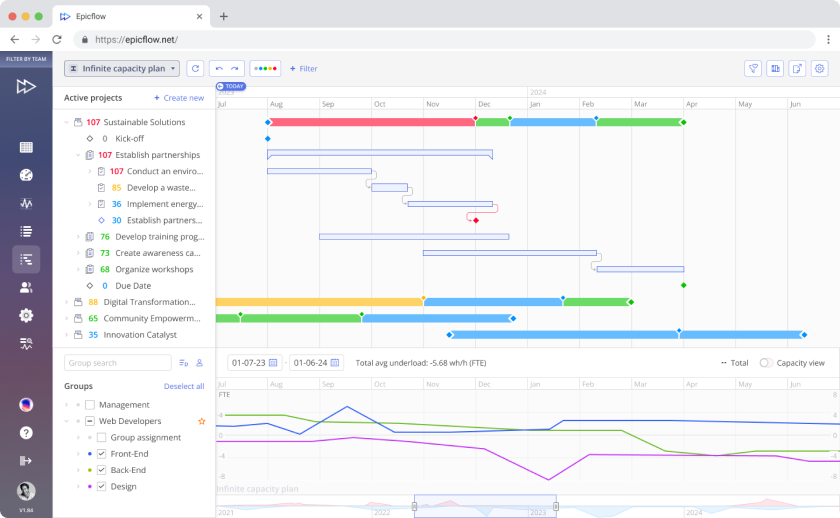
Epicflow is a cloud-based, resource-centric project and portfolio management platform designed to prevent overload and bottlenecks in multi-project environments. While rooted in CCPM principles, Epicflow extends the methodology with a strong emphasis on resource availability, capacity buffers, and skill-based prioritization.
Epicflow is best understood as a modern evolution of CCPM, optimized for organizations where resource constraints and skill scarcity are the dominant challenges.
How Epicflow supports CCPM in 2026
Time and capacity buffers for earlier warning
Epicflow supports traditional CCPM time buffers while extending the concept with capacity buffers that protect resource availability. By monitoring both schedule progress and resource load, the platform provides earlier warning signals than time-based buffers alone.
Buffer status is visualized through intuitive, modern views such as bubble graphs and risk-based color coding. This allows managers to quickly identify which projects are at risk due to either schedule pressure or resource overload.
Continuous, priority-driven resource management
Epicflow’s core strength lies in its continuous analysis of resource workloads across all active projects. Its prioritization engine ensures that when multiple tasks compete for attention, resources are always directed to the most critical work first.
The platform supports effort-based planning, distributing work dynamically according to available capacity rather than fixed dates. This approach reduces multitasking, prevents overload, and improves overall flow in environments with many parallel initiatives.
Advanced skill-based task assignment
Epicflow offers one of the most comprehensive competence management systems among CCPM-capable tools. Managers can define unlimited skills and proficiency levels for each resource and specify required competencies for tasks.
The system actively assists in matching tasks to the most suitable resources, highlighting perfect matches as well as gaps or mismatches. For large organizations with diverse skill sets, this capability significantly improves both planning quality and execution efficiency.
Modern, accessible user experience
Epicflow is fully web-based with a modern, mobile-friendly interface. Dashboards provide clear visibility into portfolio health, resource utilization, and task priorities. Team members interact with simple, prioritized task lists, reducing cognitive load and improving focus.
The platform includes AI-driven forecasting to predict future bottlenecks and integrates with tools such as Jira, making it well suited for hybrid Agile–CCPM environments.
Designed for scale and complexity
Epicflow is explicitly built to scale across hundreds of concurrent projects and thousands of resources. Its cloud architecture and analytics-driven design allow it to process large datasets and deliver actionable insights even in very complex portfolios.
While it does not yet have the decades-long enterprise track record of some classical CCPM tools, Epicflow directly addresses modern challenges around resource scarcity, skill constraints, and dynamic prioritization.
Best for / Not ideal for
Best for
-
Organizations managing large, resource-constrained portfolios
-
Environments where skill availability is a critical constraint
-
Enterprises seeking continuous prioritization across projects
-
Hybrid Agile–traditional execution models
Not ideal if
-
You want a strictly classical CCPM implementation
-
Portfolio size is small or resource constraints are minimal
-
You prefer static plans over continuous reprioritization
-
You require long-established vendor track records
Comparison Summary
All tools covered in this guide support the core CCPM concepts of buffering and resource-aware scheduling. However, they do not solve the same problems, and treating them as interchangeable is a common reason CCPM implementations disappoint.
The real differences between CCPM tools in 2026 lie in how they handle flow, constraints, and organizational reality at scale.
Buffer management: from reporting to intervention
Every tool implements CCPM buffers, but they use them very differently.
Classical CCPM tools such as ProChain, BeingManagement, and Exepron rely heavily on fever charts and buffer penetration visuals to signal risk during execution. This works well in structured, plan-driven environments.
Tools like LYNX and Aurora-CCPM go further by recalculating buffers dynamically when plans change, keeping buffer signals relevant in volatile environments. Realization takes a different approach altogether, focusing less on visual tracking and more on preventing buffer consumption through execution discipline and readiness controls.
Epicflow extends the concept by introducing capacity buffers alongside time buffers, allowing earlier detection of risk driven by resource overload rather than schedule slippage alone.
Resource management: the true differentiator
Resource management is where CCPM tools meaningfully separate.
-
Aurora-CCPM excels at solving extremely complex, multi-project resource-constrained scheduling problems through sheer computational power.
-
Epicflow focuses on continuous workload balancing and dynamic reprioritization, ensuring resources always work on the most critical tasks.
-
LYNX, ProChain, and BeingManagement emphasize portfolio-level flow control by managing project release, WIP, and shared bottlenecks.
-
Exepron takes a lighter approach, ensuring feasibility at planning time rather than continuously optimizing execution.
-
Milliarum leverages SAP’s resource data to align project planning with operational reality, but only within SAP-centric environments.
If resource scarcity is not explicitly addressed, CCPM rarely delivers sustained benefits.
Skill constraints: increasingly decisive in 2026
Skill availability has become one of the most critical constraints in modern project portfolios.
Epicflow and LYNX are the clear leaders here. Epicflow provides explicit, real-time skill and proficiency matching, while LYNX integrates skill definitions into planning and even tracks skill-based buffer consumption.
Most other tools treat skills indirectly. ProChain, Allex, and Exepron rely on role-based assignments. Realization and Milliarum depend on external enterprise systems such as ERP or HR platforms to account for skills, rather than managing them directly within the tool.
For organizations with highly specialized or scarce competencies, this distinction is often decisive.
Scalability: different kinds of “enterprise-ready”
All tools claim enterprise scalability, but they scale in different ways.
-
Aurora-CCPM is built for extreme scale, handling massive schedules and portfolios with no practical size limits.
-
LYNX and Realization have proven themselves in very large, global organizations, handling complexity rather than just volume.
-
ProChain and BeingManagement have large installed bases, reflecting trust in stable, traditional enterprise environments.
-
Epicflow scales through cloud-native architecture and analytics, performing well in large, resource-heavy portfolios.
-
Exepron and Allex scale more easily in terms of deployment and adoption, but may require segmentation in very large portfolios.
-
Milliarum inherits SAP’s scalability, making it viable wherever SAP already governs project data.
Usability and integration: adoption versus control
Usability often determines whether CCPM survives beyond the PMO.
LYNX, Epicflow, and Allex offer modern, accessible interfaces and support hybrid execution models, making them easier to adopt across teams.
ProChain, BeingManagement, and Milliarum rely on more traditional interfaces, which are familiar in their respective ecosystems but less flexible.
Realization prioritizes execution discipline over flexibility, using simplified task lists backed by strong change management.
From an integration perspective, LYNX, Aurora, ProChain, and Realization integrate well with enterprise ecosystems (ERP, MS Project, Jira). Milliarum is SAP-native by design, while Epicflow and Allex offer modern APIs and Agile tool integrations.
Bottom line:
All CCPM tools manage buffers.
Only a few manage organizational reality.
The right choice depends less on feature completeness and more on whether the tool can enforce priorities, respect constraints, and remain usable at the scale and complexity your organization actually operates in.
Recommendations for Large Businesses
For large enterprises seeking CCPM software, the best choice depends on organizational needs and context, but a few options clearly rise to the top:
Lynx (A-dato)
Best all-round enterprise CCPM tool.
Lynx offers a balance of powerful features (buffers, resources, skills) with user-friendly design. Its advanced scheduling engine and integration of skill management make it ideal for complex organizations that want state-of-the-art capabilities. It also supports Agile practices, which is great for modern enterprise teams. Lynx is recommended for companies that value flexibility (it can adapt to different PM styles) and have a mix of software/hardware projects or distributed teams. With successful use cases in large manufacturing and tech companies, it is a top pick for enterprise CCPM.
Ready to try LYNX for yourself? Click here to request a free demo and consultation with one of our experts.
ProChain (Fusion)
Proven choice with wide adoption.
ProChain’s solution is time-tested and has the largest user base. It’s particularly suitable if your organization already uses Microsoft Project or has a traditional project management culture, since ProChain will enhance (not replace) existing processes. ProChain excels at multi-project synchronization and has all necessary CCPM features (buffer tracking, pipeline management) to deliver rapid results. Enterprises that need a reliable, no-nonsense CCPM system and strong vendor support for training should consider ProChain. It may not have newer bells and whistles like built-in skill matching, but it’s a rock-solid foundation for CCPM with the credibility of many successful implementations.
Realization (Concerto/Streamliner)
High-impact solution for transformative results.
Realization is ideal for large organizations that not only want software but also a change in project management approach. It has a record of very high performance improvements in throughput and lead time. If your enterprise projects chronically miss deadlines or you have massive, complex operations (like maintenance, EPC projects, etc.), Realization’s combination of software and methodology could be the best fit. It requires leadership commitment (since it often comes with process changes), but the payback can be substantial. Also consider Realization if you need integration with heavy systems (they have experience linking to ERPs and custom workflows) and if having priority-driven execution across the whole company is a priority.
Conclusion
In conclusion, large businesses should choose a CCPM solution that aligns with their project complexity, resource management needs, and existing processes. Tools like Lynx, ProChain, Realization, and Aurora have robust features for buffer management, resource leveling, and scaling across the enterprise, making them safe bets for most scenarios. Newer solutions like Epicflow and Allex offer innovative takes, particularly in resource skill management and user experience, which can be advantageous in the right context. It’s advisable to trial one or two top candidates with a representative project, involve both project managers and team members in the evaluation, and assess integration requirements. By doing so, you can select the CCPM software that best boosts your organization’s project performance and fits your enterprise environment for the long run.
Go with the Lynx, the best CCPM software. Get started now.